
Every theme in GammaOS Nano moves the same way, so once you learn it in one home you know them all. Here is how to get around quickly with your controller (and with touch, if your handheld has a touch panel).
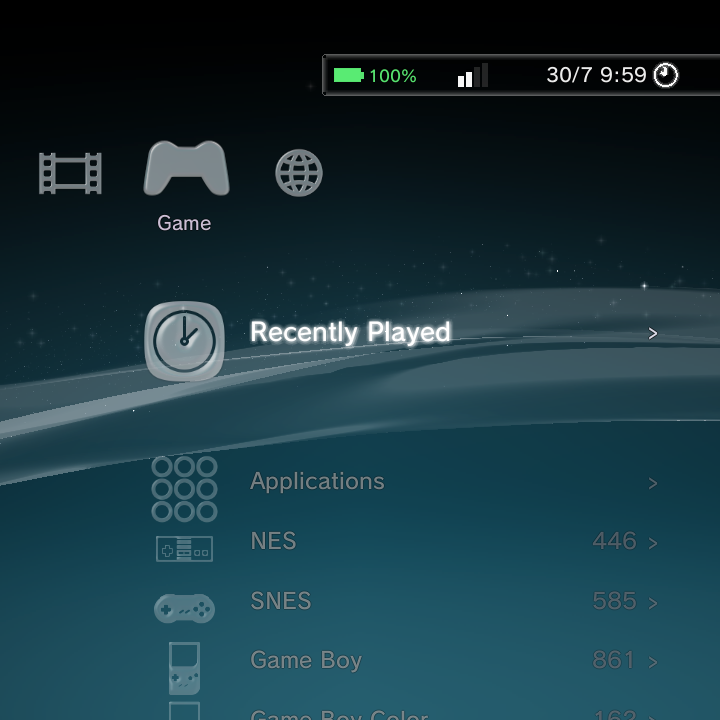
The core controls
Four buttons do almost everything on the home:
| Button | What it does |
|---|---|
| D-Pad | Move around. Up/Down move through a list, Left/Right move across XMB categories |
| A | Confirm or launch the highlighted item (also opens a submenu) |
| B | Back one level, exit a submenu, or close a dialog |
| Options | The Options button (Triangle glyph) opens the context menu for whatever is highlighted |
The Options button is the same physical button as X on the pad. You can also open the Options menu with Tab on a keyboard or a middle-click with a mouse.
A couple of extra buttons come in handy on the home:
- Y cycles Sort By in game and media lists (in Music it cycles the visualizer, in Photo it swaps 2D/3D).
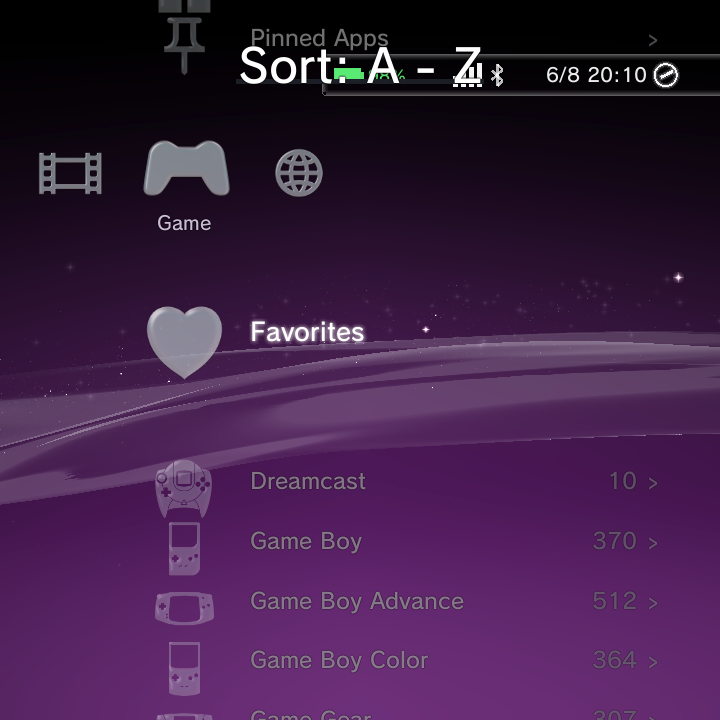
- Y on the Game category header cycles the system tile order: Default, A to Z, Most Games, By Manufacturer. This is a display order only and never reorders your actual collection.
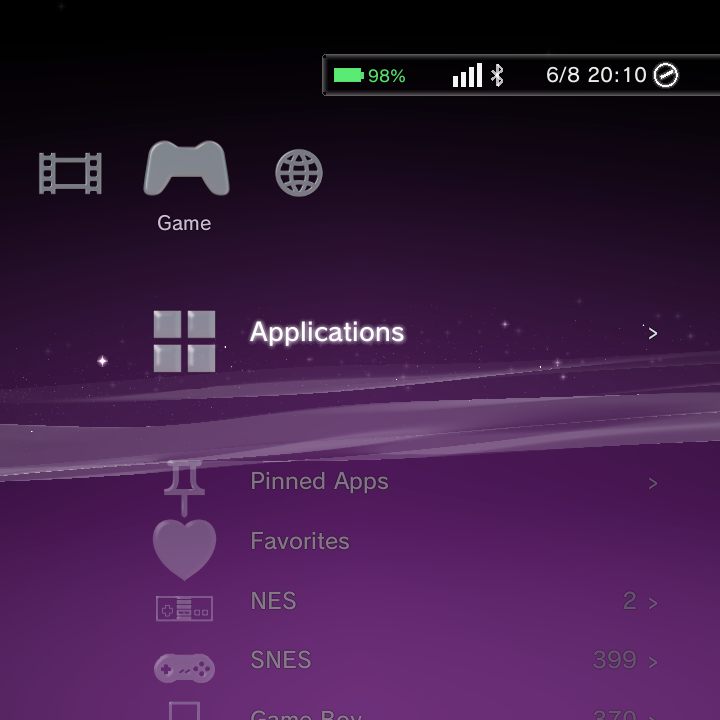
- Y on any app pins or unpins it to the home. Pinned apps gather in a Pinned Apps row under Game, kept across restarts.
- Select opens global Search from anywhere on the home.
When you sort games, switch to a folder view or pin an item, a centred banner confirms the change. It now renders at a readable size with a solid backdrop in all three themes.
Hold to scroll faster
Long libraries are no problem. Hold a D-Pad direction and the list starts to accelerate: it begins after a short delay, then speeds up the longer you hold, so a big collection flies by. Let go to stop on the item you want. This accelerating scroll now works in DSi and Minima game lists too, not just XMB.
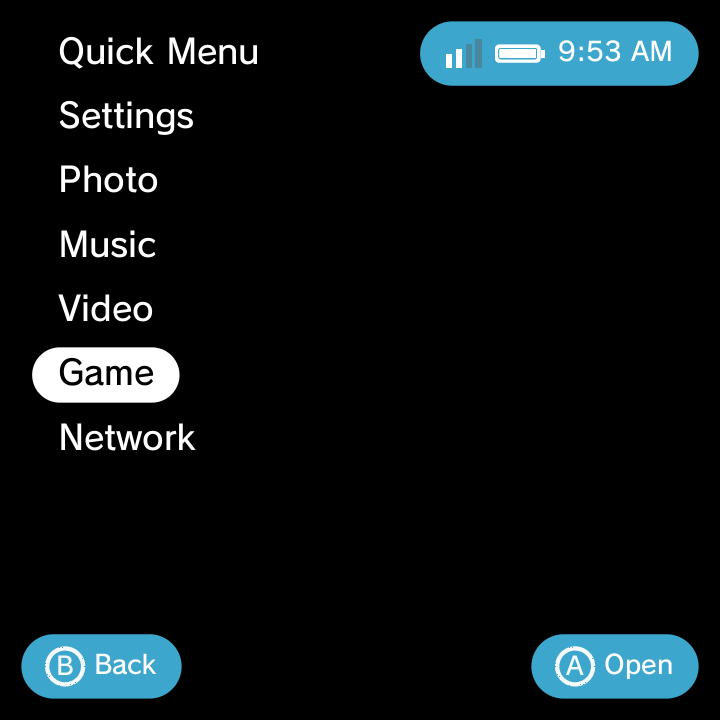
The DSi carousel at the top level scrolls at a steady, gentle pace, and only kicks into the accelerating scroll once you drill into a list. Minima and DSi keep that same carousel cadence at the top level.
Page-skip and reordering with L1 / R1
The shoulder buttons give you big jumps and quick reordering:
- Inside a drilled game or media list, L1 jumps back 10 items and R1 jumps forward 10 items. This is the fastest way through a large library, and it now works in DSi and Minima lists too.
- On the home level (on a game-system row), L1 and R1 reorder that system up or down the list.
- Also at the home level, L1 can toggle XMB / text mode and R1 can toggle Quick Resume.
On single-screen DSi, Game Information pages across L1 / R1 instead of overlapping, so a long synopsis turns one clean page at a time.
Lists wrap around
You never hit a dead end. Press Up on the first item and you wrap to the last item, and press Down on the last item to wrap back to the first. This wrap-around now applies in DSi and Minima lists as well, so the last item loops straight back to the first. The analog stick and HAT behave exactly like the D-Pad, so use whichever feels natural.
Spotting Favourites and Pinned Apps
Two home rows have their own icons so they are easy to recognise. The Favourites row uses a heart (drawn in glass on XMB, a flat theme-tinted glyph elsewhere), and the Pinned Apps row uses a push-pin, distinct from the Applications grid icon.
Touch, mouse and keyboard
If your handheld has a touch panel, tap a row to select and activate it, drag to scroll a list, and fling the DSi carousel (it snaps to the nearest slot). You can also drag slider tracks, tap Yes/No/OK in dialogs, and tap the dimmed area around a dialog to cancel.
USB mice and keyboards work too. For the full mapping, see Mouse and Keyboard.
Learn more
For the complete button chart and the system-wide shortcuts (like brightness and the Power menu), see OS Controls. To master the Options button, head to Context Menus.