
DraStic Nano is the Nintendo DS emulator built right into GammaOS Nano. It runs your DS games straight from the Game menu with a fast boot and a friendly in-game overlay. This page is the complete reference: how it launches, its controls, and every option in the overlay menu.
What DraStic Nano is
DraStic Nano embeds the DraStic DS core directly inside Nano, so there is no separate app to open and games boot quickly. It shares the same save data and preferences file with the stock DraStic app (com.dsemu.drastic), so any settings you change in one carry over to the other, both ways.
Nintendo DS games (.nds files) launch through DraStic Nano automatically from the Game menu. There is nothing to select or configure to make this happen.
DraStic Nano shares its saves and preferences with the stock DraStic app, so your progress and settings stay in sync between them.
Quick start: your first DS game
- Drop your
.ndsfiles in a DS ROM folder and open the Game menu. - Pick your game and press A to launch. There is no BIOS to find and nothing to set up first.
- While playing, give Back a short tap to open the in-game overlay. It now opens on a General tab with the everyday actions, and the game pauses while the overlay is open.
- To leave the game, give Back a long hold (about 1.5 seconds) to exit back to the Nano home.
Same button, two lengths of press: a short tap of Back opens the menu, a long hold exits the game.
No BIOS needed
Good news: DraStic does not need a BIOS. It has its own built-in high-level BIOS emulation, so Nintendo DS games run straight away with no BIOS or firmware files to find or copy. This is unlike PlayStation, PS2, or Dreamcast, which do need you to supply a BIOS (see Emulators).
The only "firmware" DraStic has is cosmetic DS user data (nickname, birthday, favourite colour, and menu language). It is optional, and you set it inside the stock DraStic app, not with any BIOS file.
In-game controls
The DS face buttons, D-pad, shoulder buttons, and Start/Select map to your handheld one to one (Up, Down, Left, Right, A, B, X, Y, L, R, Start, Select). The DS bottom (touch) screen is driven by your touch panel, or by a virtual touch cursor if your device has no touchscreen.
| Input | Action |
|---|---|
| Short Back / Select tap | Open or close the in-game overlay menu (the game pauses while it is open) |
| Long Back hold (about 1.5 s) | Exit the game and return to the Nano home |
| Long Power hold | Graceful power-off (auto-saves first) |
| Touch panel | Acts as the DS stylus on the bottom screen |
| Virtual touch cursor (toggle) | D-pad or left stick moves a cursor over the bottom screen; A taps or holds the stylus |
For the full controls breakdown, see DraStic controls.
The in-game overlay menu
Give the Back button a short tap to open the overlay. The game pauses while it is open, and tapping Back again closes it and resumes play. The overlay is organized into sections, covered below.
The overlay now opens on the General tab by default, so the actions you reach for most are the first thing you see. On narrow panels like the Brick the guide strip (the L/R tabs and hints along the edge) shrinks and centres to fit instead of clipping.
General
The default tab, gathering the everyday actions in one place:
- Brightness
- Performance (the same Max / Stock / Powersave mode as in Video)
- Restart Game
- Exit Game
- Power Off
- Reboot
Save States
- Save and load slots 0 to 8.
- Auto-Load toggle, so a game can pick up from your last state automatically.
- Restart Game.
Save State and Load State (slot 0) can also be bound to any button as quick actions, so you can quick-save and quick-load without opening the overlay at all. See DraStic controls for how to bind them.
Video
This is the largest section. Options that need it are marked to restart before they take effect.
| Option | Choices / notes |
|---|---|
| Shader / video filter | Linear by default; a picker of .dfx shaders |
| Screen Layout | Auto, Side by Side (horizontal), Stacked (vertical), or Single Screen |
| Layout Preset | Picture-in-picture and other presets, plus the two vertical presets below |
| PiP Opacity | 100%, 80%, 60%, or 40% |
| PiP Corner | Which corner the inset sits in |
| Screen Scaling | Stretch, None, or integer |
| Screen Gap | 0%, 8%, 16%, or 25% |
| Swap Screens | Swap top and bottom |
| Display Rotation | 0, 90, 180, or 270 |
| Layout X Offset | Nudge the whole screen display left or right |
| Layout Y Offset | Nudge the whole screen display up or down |
| Layout Scale | Zoom the screen display in or out |
| Reset Layout Tuning | Snap the three offset/scale values back to default |
| FPS Counter | Optional on-screen frame-rate readout (default Off) |
| Hi-res 3D | Default On; doubles the internal 3D render resolution |
| Threaded 3D | Default On; multi-threaded rasterizer |
| Disable Edge Marking | Default On |
| Frame Sync | Default Off; phase-locks the two panels on dual-screen devices |
| Frameskip | Type plus value |
| Performance Mode | Max, Stock, or Powersave |
| Half Resolution | SF render option, default Off (see below) |
| 16-Bit Layout | SF render option, default Off (see below) |
| SF Vsync Lock | SF render option, default Off (see below) |
Adjustable screen layout
The Layout X Offset, Layout Y Offset and Layout Scale rows let you nudge and zoom the on-screen display to line it up exactly on your panel, on top of the chosen layout. Reset Layout Tuning snaps all three back to their defaults if you want to start over.
Vertical layout presets
Two vertical presets stack the two DS screens for portrait-friendly play:
- Big Top + Small stacks the two screens directly at fixed sizes (768x576 on top, 512x384 below), with a Swap toggle to put the small screen on top instead.
- Big Top + Tiny is a dynamic preset: it fits the big screen to the full panel width along the top, then gives whatever height is left to the tiny screen at the bottom. This adapts to your panel rather than using fixed sizes.
On-screen FPS counter
Turn on the FPS Counter to show the present rate in the top-right corner. It measures over a rolling one-second window and is sized to stay readable at any resolution. It is off by default.
SF render options (opt-in)
These three options are aimed at fill-bound panels and are all off by default. Leave them off unless you need the extra headroom:
- Half Resolution renders at half size and nearest-upscales, cutting the fill cost to about a quarter.
- 16-Bit Layout composites in RGB565 to halve the display bandwidth.
- SF Vsync Lock phase-locks the present loop to the panel's vblank for a steadier cadence.
Audio
- Volume, 0 to 10, applies live.
- Audio Latency, 0 to 4, applies on the next launch.
Controls
Rebind DS buttons, choose analog stick modes, toggle the virtual touch cursor, and set portrait control rotation.
Cheats
Enable or disable per-game cheats, and add your own custom cheats. Cheats are stored per game code, so they follow the right game.
Achievements
RetroAchievements login, your unlock list, and leaderboards. On dual-screen devices this uses the bottom panel.
Recommended defaults
On dual-screen devices GammaOS already sets sensible defaults for you, applied without overwriting your own choices:
| Option | Default |
|---|---|
| Frame Sync | On |
| Hi-res 3D | On |
| Threaded 3D | On |
| Disable Edge Marking | On |
Firmware and DS user data
Your DS firmware personalization (Firmware Language, colour and theme, birthday, and nickname) is read at launch from the shared preferences file. These are not editable in the in-game overlay.
DS games now boot with your chosen Firmware Language (and system name, birthday and colour) from those DraStic settings, instead of always defaulting to English. Set a non-English firmware language once and every game respects it.
To change them, open the stock DraStic app once, set them there, then relaunch your game from Nano. The stock app is also where you set the full keymaps.
| Setting | Default |
|---|---|
| Language | English |
| Nickname | Dr Drastic |
| Birthday | June 6 |
Save location and syncing
DraStic Nano keeps your DS saves, its config and any BIOS files with the stock DraStic app, so both the built-in emulator and the standalone app read the same data.
You can now point everything at a folder you choose from Settings > Game Settings > DraStic Data Folder. Set a Custom DraStic Data Folder on shared storage and your saves, config and BIOS all live in one place you can reach from a file manager, from a PC over MTP, or off the device entirely.
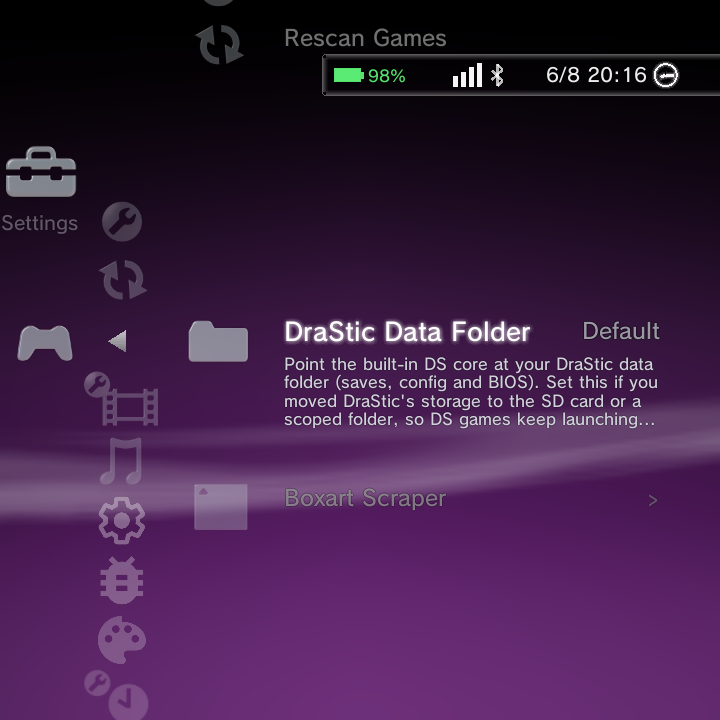
To keep the standalone DraStic app pointed at the same folder, open it and set its own Settings > Data Location to match. With both pointing at one folder, a game saved in Nano is instantly available in the standalone app and back again.
Because that folder is ordinary shared storage, a tool like Syncthing can mirror it to a PC or another device, so your DS saves follow you between machines. Point Syncthing at the same DraStic Data Folder on each device and let it keep them in sync.
Quick Resume
With Quick Resume enabled (default On, toggled on the Nano home with R1 or in the setting), powering off or rebooting while in a DS game force-saves to DraStic's reserved autosave slot (slot 9). On the next boot, Nano relaunches straight back into your paused game with no load screen.
There is a built-in crash guard: if an autosave is truncated or too small, it is quarantined and the game boots fresh instead of loading a corrupt state.
Quick Resume is skipped for RetroAchievements hardcore mode, which requires a fresh boot.
DraStic has the most seamless Quick Resume of any emulator on Nano. For the full picture, including how it works for RetroArch, see the Quick Resume page.
Where DS options live
| Where | What you set |
|---|---|
| In-game overlay (short Back) | Most video, audio, cheat, and control settings, live |
| Nano home | Quick Resume on or off |
| Settings > Game Settings | Custom DraStic Data Folder (shared save/config/BIOS location) |
| Stock DraStic app | Firmware user data (language, nickname, birthday, colour) and full keymaps |
All of it round-trips through the shared preferences file, so the built-in emulator and the stock app always stay in sync.